Shigatse
Introduction
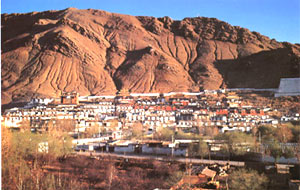
Shigatse is located mostly between the middle of the Himalayas and the middle of Kangdese-Nyainqentanglha ranges. this land has a varied topography with an elevation of more than 4,000 meters. Shigatse connects with three countries of Nepal, Bhutan and Sikkim in the south, Ngari in the west, Nagqu in the north and Lhasa and Shannan in the east. It occupies an area of 1,76,000 sq km, the latitude being between 82'E and 92'20"E and latitude between 27'23"N and 31'49"N. It is 800 kms from east to west and 220 kms from north to south, with a border of 1,354 kms.Shigatse was known as Tsang, which was an important administrative district of Tibet. During the region of the Tubo Kingdom, the ruling class divided its central part into two divisions of wei an Tsang according to geographic condition, Tsang, with Shigatse as its center, was again divided into Yeru. Shigatse had also set up countries like Rinbung,Shigatse,Bainanag and Gyangze. Early the last century, the Tibetan government promoted Shigatse to the level of Gyizong (district), which had under its juridstion 16 countries and 30 or so independent Shikhas (manor). After the peaceful Liberation of Tibet in 1951,two branch working committees were established in Shigatse and Gyangze,respectively.|
-: Facts & Figures :- |
|
| Area | 17,6000 sq km. |
| Population | 609,228 |
| Altitude | 82'E & 92'20"E longitude 31'49"N & 27'23"N latitude |
| Language | Tibetan, Chinese, some English |
Climate :
Shigatse :Summer is normally mild and wet, and brings most of the annual rainfall. Winter is cold, dry and windy. Relatively low temperature with large daily differences but small annual differences. the average daily temperature differential in the northwest is 16degrees centigrade while in the east it is 14 degree and from October to April is the dry and windy season with low temperature and less than 10% of the yearly rainfall. It is a warm year round with plenty of rain, the annual rainfall i around 1,000 mm and the average daily temperature in the warmest season is 18 to 22 degree centigrade.
Tourist Attraction :
Tashilhungpo Monastery :
 Tashilhungpo MonasteryTashilhungpo Monastery located in southern slope of the Nyima Mountain to the west of the Xiage City. Monastery was built in 1447.The monastery was built under the supervision of the first Dalai Lama Zhuba, a discipline of Zongkapa, the founder of Yellow Sect. The complex is built symmetrical against the Nyima Mountain its wall, over 3,000 meters long and built according to the topography of the mountain, surrounds 57 buildings, or more than 3,600 rooms.
Shalu Monastery :
Shalu monastery is located 20 kms southeast of Xiang. It was built in 1087. It demonstrates a combination of the Tibet and Han architectural styles. The monastery is around 19km of south -east of Shigatse, A few kms of the Shigatse-Gyantse road is easily spotted because of its Chinese-style green tiled roof. It is said that for years the water does not decrees. The murals in the monastery are rich in contents and excellent in workmanship and are one of rare fine arts in Tibet.
Xalhu Monastery :
Xalhu monastery is famous for its four treasures. the first is the printing plate of Buddhist scriptures, which is made of 108 blocks of wood by Abbot Purdain. The second treasures is the holy jar made of bronje. It is claimed that inside the jar is the clearest water in the world, which is replaced every 12 years. The mouth of the jar is covered with red cloth. Legend says that the water can cure diseases and wash away dirt and filth. The third is the stone tablet with six characters. The fourth is the huge basin-shaped stone in which the living Buddha Jigzun Xerab Qoinnyai, who built the monastery of Sagya.
Sakya Monastery :
The southern monastery is composed of southern and northern Monasteries. The northern monastery was built in 1097 and was damaged. Now while Southern Monastery was rebuilt in 1268. It houses a great amounts of cultural relics including the titles, seals, crowns, garments and ornaments awarded by the Yuan imperial court to the local officials, the statues of Buddhas,rituals instruments and porcelains from the song, Yuan and other later dynasties, and the precious murals of historical themes. It preserve great numbers of books such as the "Bakgyur","Bstanggyur", and other Tibetan classics on astronomy, history, medicines and literature.
Open hours: 9:00- 12:00 and 15:00-16:00
Palha Manor :
Palha is located in the Banjorlhunbo Village of Jangra Town. Its just located 4 kms of the Southwest of Gyangze Country. It was originally the chief of a tribe in Budan.Palha Manor is only the best-preserved noble manor in Tibet. There are 57 rooms, including prayer rooms,guestrooms,etc. , and all of the are decorated with gold, jade articles and silvers, making it looks grand and magnificent.
Rongpu Monastery :
The monastery is 90 kms away from the Tingri country seat and is 5,800 meters above sea level, the highest of its kind in the world. It is 60 kms from New Tingri to the Rongpu Monastery.
Makaru Mountain :
Makaru Mountain, the fifth highest peak. It is 8,463 meters above sea level and its straight distance to Mt. Oamolangma is 24 kms. The mountain has five ridges. The weifing Peak on the southeast ridge is the highest, being 80,10 meters above sea level. In the valleys and slopes are glaciers. Snowslided or icefalls always happen in the craks of the saw-shaped cliffs. The peak on the Southeast Ridge is at the an altitude of 8101 meters, a bit higher than others.
Luoze Mountain :
In Tibetan, Luoze means a green beautiful fairy maiden. The 8,516-meter-high Luoze Mountain is three kms to the south of Mt. Qomolangma. By the fairy maiden has precipitous steep and a changeable climate. From early June to mid-September, it has many snow slides and storms. in the winter the temperature will be -60 degree.
Mt. Qumolangma :
Means "The Third Goddess". Its located in bordering areas with Nepal in Tingri country, it is 8,848.13 meters high, the tallest mountain in the world. In the area of 5000 sq km around the mountain, there are four peaks being more than 8,000 meters high and 38 peaks being more than 7,000 meters high. The monastery ahs become a camp of mountaineers from northern slope to Mt Qomolangma. On the northern slope of the peak there are 217 glaciers with the Rongpu Glacier being the largest.
Lake Paiku Co :
The lake is the highest of its kind in Xigaze Prefecture and covers an area of more than 30 sq kms. In the breast of the three mountains ,the lake is rich in fish resources. Its neighboring areas are inhabited by wildlife such as wild horses, wild donkeys and yellow ducks.
Yamdroktso :
On the old road between Gyantse and Lhasa, the dazzling Yamdroktso can be viewed from the summit of the Kamba-La Pass the lake is fabulous shade of deep turquoise. Leaving Yamdroktso is as spectacular as arriving, since you have to cross the 5045m Karola, with its awesome roadside views of the Kangtsang Glacier.
Hotels in Shigatse :
Four Star Hotels In LhasaHotel Shigatse | Shandong Mansion Hotel Shigatse